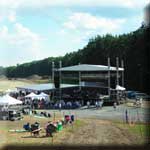
When Mountain Park closed, Jay realized he had taken hardly any photos of the park. So he began taking as many as he could. The collection below includes those images, plus some from when the park was open and some from the park's archives.

The Mount Tom Summit House Mountain Park (where the Stardust Ballroom was constructed) was the final stop for Holyoke's trollies. The park was a restful layover area. From there people could take a cable car to the Summit House. This photo shows the second version to be built on the summit of Mount Tom, and it was impressive. The first building burned down in 1900. This massive gold-domed structure succumbed to fire in 1929. A small metal replacement building was erected, but wasn't a draw and was torn down shortly after (along with the ingenious cable car system). The site is now occupied by communications towers. The original trolley route is now a paved road leading up to the towers. The Summit House foundation is still there, overlooking the valley.
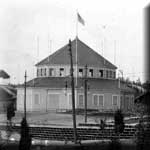
Dance Hall, 1895 This building remained the oldest in the park until it was burned to the ground in 2003. It began life as a dance hall, then was converted to an arcade and in 1929 became the home for PTC carousel #80. Notice the original roller coaster, a switchback railway, in the background.
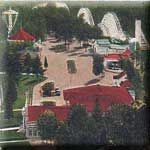
The Stardust Ballroom This old postcard shows the popular Stardust Ballroom and the Tap Room (restaurant) that tragically burned down in 1971. The colorful flowers surrounding the building were a hallmark of the park; beautiful landscaping abounded.
The original entrance gate "MT PARK" was welded onto this gate that served as the main entry before Interstate 91 was built. In the background is the park's red storage building, the Mt. Flyer turnaround and the Clambake Pavilion.
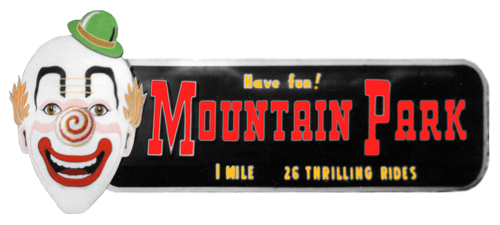
The Route 5 billboard When the Collins family bought the park in 1952, they had Ed Leis and Dominic Spadola build this spectacular billboard on their property, a mile north on busy Route 5. The clown's nose would slowly spin. Along the mile of roadside heading toward the park hung a tantalizing series of 4-foot-square green metal signs built by Roger Fortin that successively named each ride in the park.
The old park road sign Shrouded by trees, this once-clear sign stood at the old north-bound park entrance on Route 5.
The Boats, 1953 The gas-powered boats floated in a concrete oval pool that had a divider down the middle. The ride, designed by Ed Leis, was installed by John Collins when he bought the park, but removed a few years later. The boats were just too large for the size of the trough and kept getting jammed. And operators kept falling into the water. So the pool was filled in and made into the Hot Rods, a go-cart track. In the 1970s, the area became the new homes for the Scrambler and Bubble Bounce.
It's Fun to Get Lost Ed Leis and Dominic Spadola built this two-level walk-thru fun house in 1960. A terrific mirror maze greeted guests on the left. In the center above was a corridor with air jets. On the right was the Magic Carpet, which dumped guests unceremoniously down a slide and to the exit.
Another version The Fun House facade was reworked time and time again over the years. Here's a view from about 1966, with the lettering re-designed and a large clown head in the center (similar to the one on the billboard). The Magic Carpet became a liability issue, so it was removed and park supervisor Roger Fortin instead built a tilty room section onto the back of the building.
Another clown Dominic Spadola create this giant clown that rested atop a large billboard in the 1960s, advertising the park.
An aerial view from 1962 Massachusetts began building Interstate 91 in 1963. A year earlier, this shot was taken to show how the Mountain Park property was going to be bisected by the road. The famous Mountain Park Casino is clearly visible in the center right of the image.
The new Route 5 billboard This simple but colorful sign replaced the clown in the late 1970s and remained until the park closed.
Ticket booth for the Casino Hidden by vines and trees in 1988, this was the only remnant of Mountain Park's Casino: a rustic little booth where tickets were once sold.
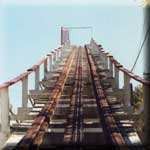
The carousel entrance road This is the road I walked up so many times when I was a child. If we brought a picnic lunch and set it up in the grove, this was the main entrance to the park. Through the screen windows of the building on the left I could see the tantalizing lights spinning on the carousel and hear the band organ. The pungent smell of graphite and loud screams and rumblings came from the Dodgems on the right, along with dancing sparks from the arcing conductor poles. The first drop of the Mountain Flyer was straight ahead, and the Cotton Candy stand was clearly visible. What a sight for a kid!
Pippo James Parson, known to everyone at the park as Pippo, ran the games for many years. He could most often be heard at the Dolly Pitch game, calling out for guests to throw a dime in a bowl and win a prize.
The Grocery Game A small booth across from the main office was home to this most popular game in the park. A dime placed on the correct number would win. In the 1980s, Walter Marek was in charge of purchasing the goods which he bought at local grocery stores. The prizes were a mixture of canned food, boxes of pasta or cereal and kitchen items.
Grocery Clown Another Spadola creation that used to hang on the side of the Grocery Game.
The Dodgem Wall When the Collins family took over the park, a wall of mirrors and lights was added to the back of the Dodgem car building. At night it looked spectacular.
Dodgem girl A Spadola plywood cutout that used to hang in the Dodgem building.
The Mini Arcade clown Across from the Clambake Pavilion was the Mini Arcade, which housed some Skee Ball and pinball machines. This clown head hung on the side facing the Flying Jets.
The Mini Arcade wall After the games were removed, the colorful Spadola-painted back wall of the Mini Arcade was clearly visible. The wall was built up on top of a section of the old trough from the boat ride.
Fiberglass elephant This eight foot high fiberglass beast stood in a fenced-off grassy area between the Dodgems and the Skyride. This shot was taken in the winter, when it was moved under the Dodgem's protective roof. I don't know if Dominic built the animal, but he did paint it. I had the job of re-painting it before it was sold in 1988. I was no match for Dominic's talent.
The Goodwins Roger and Maryann Goodwin sold cotton candy, candy apples, caramel apples with nuts and their specialty -- frozen chocolate bananas -- from a little stand between the merry-go-round and the Tilt-a-Whirl.
The Cowboy This was a fixture at the park for many years. It could also be found at other small parks around the country. It was a fiberglass cowboy that sat on a bench in front of the Puffing Billy ride. Guests could sit next to him and have their picture taken. This is one of the most vivid memories that people still have of the park.
The Clambake Pavilion It was at various times a roller rink, a dance hall, a dining area and the place where every Sunday Larry Chesky and his band would play polka tunes. Walter Marek called Bingo numbers from the stage. It was the main gathering area, and usually the first thing people saw as they came to the park. Roger Fortin helped build the giant wooden arches that supported the roof. This picture was taken over the winter when the rides were in storage. In the distance is the counter area where beer was served. The pavilion was the first building to burn to the ground.
Stage figure This was one of the many fanciful cut-outs that was affixed to the back of the pavilion stage.
Woman's head Here's another Dominic Spadola creation made of homosote that hung in the park.
A night ride on the Satellite The Klaus Satellite Jets, built from discarded tank parts (the lower portion was actually a tank turret), provided not only a thrilling ride but a spectacular view of the park and the surrounding valley.
Warning sign I originally thought this was from the Mountain Flyer. But I now I'm pretty certain it was the first thing you saw on the Dinosaur Den as you went through the entry doors.
Winter panorama, 1987 Taken from Cedar Knob, the hill above Interstate 91, this image shows the entire park plus the now-closed Mount Tom Ski Area in the background. The Mount Tom summit is on the left.
The last ride In 1988, John Hickey and Angela Wright held a fundraiser at the park. Roger and I fenced off the midway around the Merry-Go-Round. Over 1000 people came to the park that day for the last time to donate money and take a ride. On the left of this photo is Terry Lyons, the final Merry-Go-Round operator when the park was open.
Merry-Go-Round building, 1988 This shot was taken after the fundraiser to save the Merry-Go-Round for Holyoke. Notice the large circular outlines where Dominic's colorful paintings used to hang. Also, note that the large entrance sign is attached to the exit gate; the signs had been swapped for the fundraising event.
The Mountain Flyer falls, 1990 Allard construction company was called in to remove the structure of the Mountain Flyer. It took them nearly two weeks to rip it down; the old ride wouldn't budge. Here Roger Fortin watches as a backhoe digs into the turnaround.
The fun houses burn, 2002 Vandals started a fire in the Dinosaur Den and within minutes it spread to the Pirates Den. Holyoke firefighters responded quickly and were able to contain the blaze and save the park office. Ironically, a few months later the firefighters were given permission to test a new flame retardant material on the remaining buildings. The flame retardant material failed and the rest of the midway down to the Pop It game burned to the ground. Along with park records and office equipment, dozens of vintage photos that hung in the office were lost forever.
South Midway, November 2006 Former park supervisor Roger Fortin stands on the track of the Cutie Caddy, next to the remains of the Dolly Pitch stand.
No Trespassing This was the tantalizing sign affixed to the new parking lot gate in December 2006, after local entrepreneur Eric Suher bought the park property.
Parking Lot Panorama, May 2007 By the springtime, the old asphalt had been removed from the parking lot and the area had been graded.
Entrance to the Clambake Pavilion, May 2007 These steps once led up from the parking lot to the pavilion, where the smell of beer continuously wafted.
View from the 'new' arcade, May 2007 Most remaining structures except for some concrete slabs had been removed.
Mountain Flyer station entrance, May 2007 The colorful stone walls flanking the old Mountain Flyer entrance were still standing.
Golf Course tunnel, May 2007 The park's miniature train, the Zephyr, used to pass through this tunnel in the middle of the mini-golf course before circling around to the station. The walkway above the tunnel was for players to get safely from one hole to the next without crossing the train tracks. On either side of the tunnel used to flow lighted stone waterfalls.

Return to Mountain Park